Fix Crooked Fishgoo Cufflinks
Fix Crooked Fishgoo Cufflinks
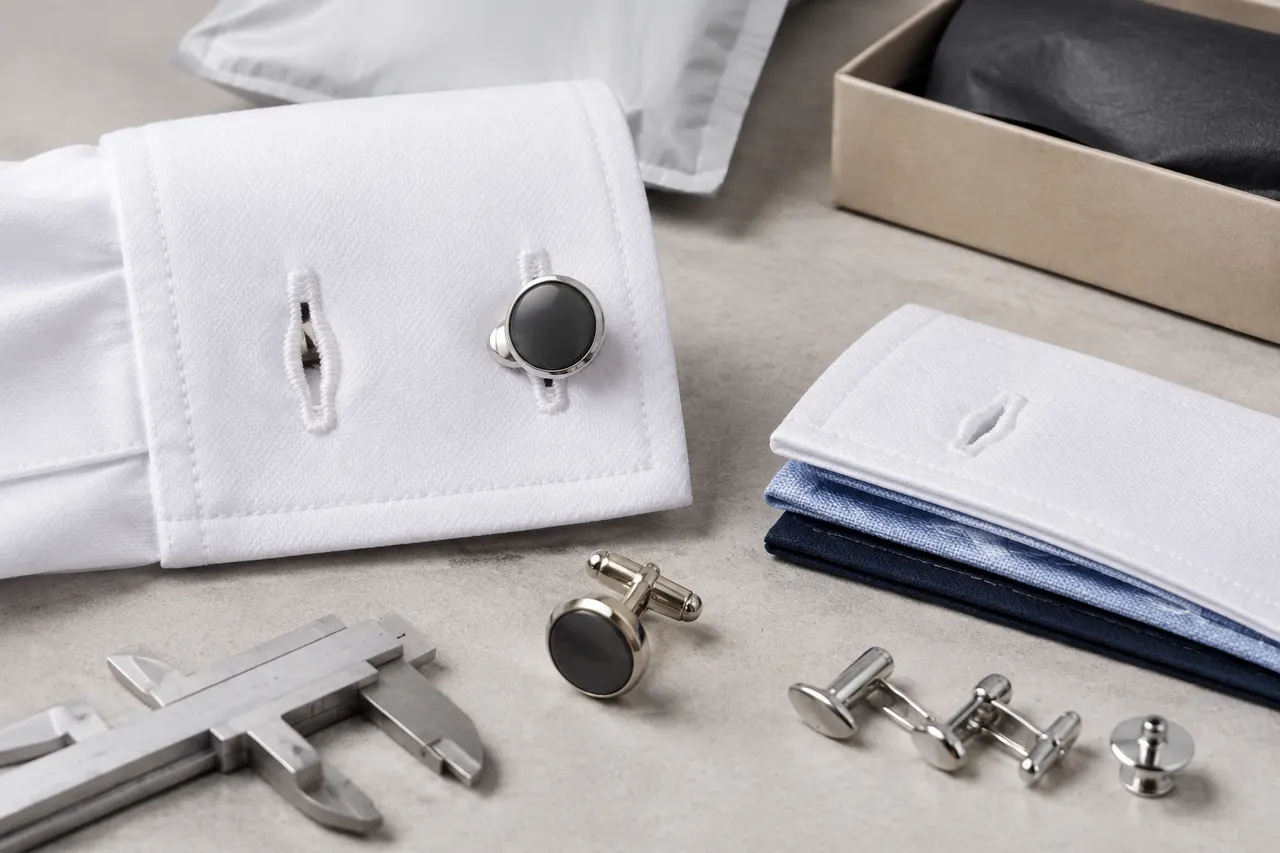
Image caption: Cufflink misalignment troubleshooting diagram, usable for recording front direction, back clasp position, and cuff fit.
Cufflinks always wearing crooked is usually not caused by a single reason. It could come from French cuff hole spacing mismatch, cuff fabric being too soft or too thick, back clasp not fully locked, or simply not pressing the two layers of the cuff flat when wearing. For fishgoo cufflinks seen on fish-goo.org, before purchasing, you should combine the product images, structural diagrams, pair consistency, and viewable quality inspection photos to judge, rather than just looking at whether the front design looks good.
This article is suitable for people who are preparing to buy or have already received fishgoo cufflinks and find that the front will turn after wearing. After reading, you should be able to judge whether the next step is to request additional photos, change to a different back clasp structure, adjust the shirt cuffs, or give up on this pairing. This article is not suitable for judging metal authenticity, brand authorization, or precious metal composition; these require seller credentials, platform descriptions, and physical testing support.
Verification date: 2026-09-06. Because product inventory, page images, shipping routes, after-sales windows, and platform page statuses can change, before publishing or purchasing, still refer to the current fish-goo.org page, seller replies, and warehouse quality inspection photos.
First confirm whether the misalignment is on one side, both sides, or only appears after movement
Don't rush to judge that the cufflinks are of poor quality. Divide the problem into three categories, which makes it easier to locate:
One-sided misalignment: Only the left hand or right hand is crooked. Common reasons are inconsistent cuff hole spacing on one side, uneven fabric folding, or different back clasp tightness on a single cufflink.
Both sides misaligned in the same direction: Both cufflinks turn in the same direction. Common reasons are the front decoration being too heavy, insufficient axial support from the back clasp, or natural rotation caused by wrist movement during wear.
Straight when first worn, crooked after movement: Normal when still, but crooked after typing, toasting, or walking. Usually related to cuff thickness, back clasp locking angle, and shirt fabric stiffness.
It is recommended to take three photos first: just after wearing, with the arm hanging naturally, and after ten minutes of activity. Take each photo from the front and the side of the cuff. This way, when communicating with the seller or platform, you won't just say "crooked," but can explain the condition under which the misalignment occurs. 📷
Check whether the French cuff hole spacing and fabric thickness match
Cufflinks need to pass through two or four layers of French cuff fabric. If the hole spacing is too wide, the cufflink post will wobble in the hole; if too narrow, the back clasp will be squeezed by the fabric, and the front will easily be pushed crooked.
When checking, follow this order:
Lay the cuff flat and confirm whether the buttonholes on both sides are naturally aligned.
Without wearing the cufflink, gently press around the buttonhole with your finger to see if the fabric noticeably collapses.
After wearing the cufflink, look from the side to see if the back clasp is pushed to an angle by the fabric.
After closing the cuff, confirm whether the front decoration is close to the fabric surface, rather than just hanging on a thin post.
Thick French cuffs are better suited to structures with sufficient post length and a back clasp with a larger unfolded area; thin and soft cuffs require a more stable back clasp to prevent the front weight from pulling the cufflink down. If fishgoo product images only show the front without side thickness and back clasp angle, before purchasing, it is best to request additional back view, side view, and pair view photos in the consultation or note section on fish-goo.org.
Locate common loose points based on bullet back, whale tail, and fixed back clasps
Different back clasp structures have different reasons for misalignment, so they cannot be judged by the same standard.
Back clasp structure | Where it easily becomes crooked | What to check before purchasing |
|---|---|---|
Bullet back clasp | Crossbar not fully turned, or post too thin causing wobble in hole | See if the back clasp can be fully locked horizontally, and whether there is a clear closed side view |
Whale tail back clasp | Flip piece not large enough, follows the cuff when moving | Look at flip piece width, whether the pivot is centered, and whether both back clasps point in the same direction |
Fixed back clasp | Cannot be adjusted to compensate for size mismatch | Look at post length, front-back spacing, and whether it suits thick cuffs |
Chain cufflinks | Large range of movement, front more likely to turn | See if the chain is too long, and whether it suits formal occasions |
If you are attending a wedding or dinner, prioritize styles with moderate front weight, clear back clasp closure, and symmetrical structure on both sides. Chain styles or heavily decorated styles have more style, but stability usually depends more on the stiffness of the shirt cuff.
Use a comparison table to determine whether the problem comes from the cufflinks, the shirt, or the wearing method
You can use a simple test to avoid misjudgment: try the same pair of cufflinks on two different shirts; try the same shirt with another pair of cufflinks. The results are usually straightforward. 🧷
Test result | More likely source of problem | Next step |
|---|---|---|
Same cufflinks crooked on multiple shirts | Cufflink structure, weight, or back clasp tightness | Request back clasp detail photos, consider changing structure |
Multiple cufflinks crooked on the same shirt | Shirt hole spacing, fabric, or cuff deformation | Change shirt, or tidy cuff before wearing |
Crooked only after movement | Insufficient back clasp support or cuff too soft | Use stiffer French cuffs, reduce heavy front |
Only one side crooked | One cufflink or one side cuff inconsistent | Compare back clasp angles and buttonhole positions on both sides |
If the fish-goo.org order enters the warehouse quality inspection stage, focus on pair photos and side photos. A single beautiful front photo cannot prove wearing stability, especially for geometric, shield, disc, animal-shaped, or thick enamel cufflinks.
Check front weight, back clasp closure, and pair consistency from product images
When looking at product images before purchasing, you can shift your attention from "does it look good" to "will it rotate." The following details are more valuable for judgment:
Whether the front is obviously heavy or off-center. If the decoration weight is concentrated on one side, it is more likely to rotate after movement.
Whether the back clasp is on the central axis. An off-center back clasp will cause uneven force on the front.
Whether the pattern directions of the two cufflinks are consistent. If the left and right pair are inconsistent, after wearing, one will appear straight and the other tilted.
Whether the post length is visible from the side. A post too long will be loose, too short may not secure thick cuffs.
Whether the back clasp closure image is clear. Only seeing the open state cannot confirm the fit angle after locking.
For fishgoo cufflinks, if the page only provides rendered images or front images, you cannot directly infer the wearing effect. A more reliable approach is to list "back clasp closure photo, side thickness photo, two side-by-side photo" as pre-purchase confirmation items.
What conclusions cannot be made prematurely when wearing photos are lacking
Lacking wearing photos does not mean you cannot buy, but some conclusions cannot be stated definitively in advance:
Cannot conclude that it will definitely be straight when worn.
Cannot conclude that it suits all French cuffs.
Cannot judge material feel or weight from front brightness.
Cannot take the posing angle in product images as the actual wearing angle.
Cannot promise stability without rotation for weddings, commuting, or dinners.
What can be judged in advance is structural risk: for example, a very thick front, a very narrow back clasp, a long post, no side image, no pair image—these all increase the probability of misalignment. In such cases, it is better to first ask the seller for additional photos, or wait for warehouse quality inspection photos before deciding whether to ship.
Temporary handling methods for wedding, commuting, and dinner scenarios
Different scenarios have different tolerances for cufflink misalignment. Weddings and dinners often involve close-up photos, making misalignment more noticeable; commuting places more importance on comfort and not coming loose.
Wedding scenario: Prioritize stiff French cuffs, and align the two layers of fabric completely before wearing. Before photos, keep the cufflink front facing outward, and avoid entering close-up shots immediately after toasting or handshakes. 💍
Commuting scenario: Avoid overly heavy, sharp, or chain styles with a large range of motion. Those who type a lot are better suited to low-profile, stable back clasp styles to reduce rotation caused by wrist friction.
Dinner scenario: More decorative styles are acceptable, but try them on for at least ten minutes beforehand. If there is obvious rotation after activity, it is not recommended to use glue, pins, or methods that may damage the fabric on the spot.
Temporary handling is only suitable for slight misalignment: re-flatten the cuff, confirm the back clasp is fully locked horizontally, adjust the cufflink front direction, and change to a stiffer shirt. Do not modify the cufflinks in ways that damage the metal, fabric, or affect return/exchange judgment.
Final decision: request additional photos, change structure, or change shirt pairing
If you haven't placed the order yet, prioritize requesting additional photos. What you need is not more heavily edited front images, but back clasp closure, side thickness, two side-by-side, and physical natural light photos. When this information is lacking, choosing a more stable structure is more practical than gambling on the design.
If already at the warehouse quality inspection stage, first see if the QC photos can answer three questions: Are the two identical? Can the back clasp close? Is the front obviously off-center? If the photos are insufficient, you can request additional shots; if the back clasp structure itself is not suitable for your cuffs, do not continue to ship just because the front looks good.
If you have already received them and found misalignment, troubleshoot in the order of "change shirt, change cufflinks, change wearing method." If the same pair of cufflinks is crooked on multiple shirts, the problem is more likely from the cufflink structure; if multiple pairs of cufflinks are crooked on the same shirt, the problem is more likely from the shirt hole spacing or soft cuff.
The final recommendation is simple: Slight misalignment that only appears after activity can be improved with stiff cuffs and correct back clasp locking; obvious off-center, loose back clasp, or inconsistent pair are better suited for requesting additional photos then returning/exchanging or changing structure. People suitable for purchasing are those willing to check details before ordering on fish-goo.org and view QC photos at the warehouse stage; people not recommended to purchase are those who need immediate stable wear for an important occasion but the page lacks back clasp and side information. ✨
Agent platform shopping FAQ
1. What should I check in QC photos on fish-goo.org?
To make the most of QC photos, concentrate on the particular attributes of the item you bought. If you ordered shoes, inspect critical points such as the toe, heel, and tongue to verify the stitching, overall shape, and tongue thickness, which help determine quality. For garments, look at the collar label, logo embroidery, material, and how neatly the collar and cuffs are finished, among other aspects.
2. Why doesn't fish-goo.org use Google Sheets?
Google Sheets works only when the product list is very short. As the number of items grows, load times increase sharply and lag becomes noticeable. This problem is worse on phones, where the interface looks cramped and finding a specific product is difficult. With the same catalog, fish-goo.org loads faster and presents a cleaner view.
3. Why do I need a spreadsheet from fish-goo.org?
Most agent platforms don't list products openly, so a spreadsheet is essential to browse items you might like and get their purchase links. As an alternative, you could ask for suggestions on Reddit or Discord—recommendations there are generally excellent, but the process tends to be slow. Spreadsheets like those on fish-goo.org are usually built gradually by collecting information from community sources.
4. Is the spreadsheet website fish-goo.org safe to use?
fish-goo.org gathers no personal data at all; it functions purely as a product directory for the agent platform. All buying and selling happen directly on the agent platform, not on fish-goo.org.
5. How can I find a product I want to buy on fish-goo.org?
Pick one word to search, or head to the category page where items are also grouped by brand. Longer search phrases usually give fewer but more exact results than shorter ones. For instance, try "Air Force 1 White," "sneakers," or just "Air Force 1" on fish-goo.org.
Browse our latest products and find your next favorite item.