fishgoo Wet-Weather Commuter Shoe Guide
fishgoo Wet-Weather Commuter Shoe Guide
When choosing wet-weather commuter shoes, you can't just look for the words "non-slip." The real task is to use the fish-goo.org product pages and available sole images to screen out candidate shoes worth further verification based on the wet and slippery surfaces you encounter daily, and to promptly drop styles with insufficient evidence.
This guide is for people who primarily commute on foot, by bus, or by subway and want to inspect the outsoles of athletic shoes before ordering. It is not suitable for workplaces requiring certified slip resistance, nor does it replace laboratory wet-surface friction testing. ☔
Verification note: As of September 3, 2026, this article has not obtained designated product samples, current prices, stock status, outsole material certifications, or wet-surface test reports. Therefore, it does not recommend specific models, nor does it present image observations as actual performance conclusions. Prices, sizes, stock, seller descriptions, fees, and purchase steps on fish-goo.org should be based on the page visible to the reader on the day of ordering.
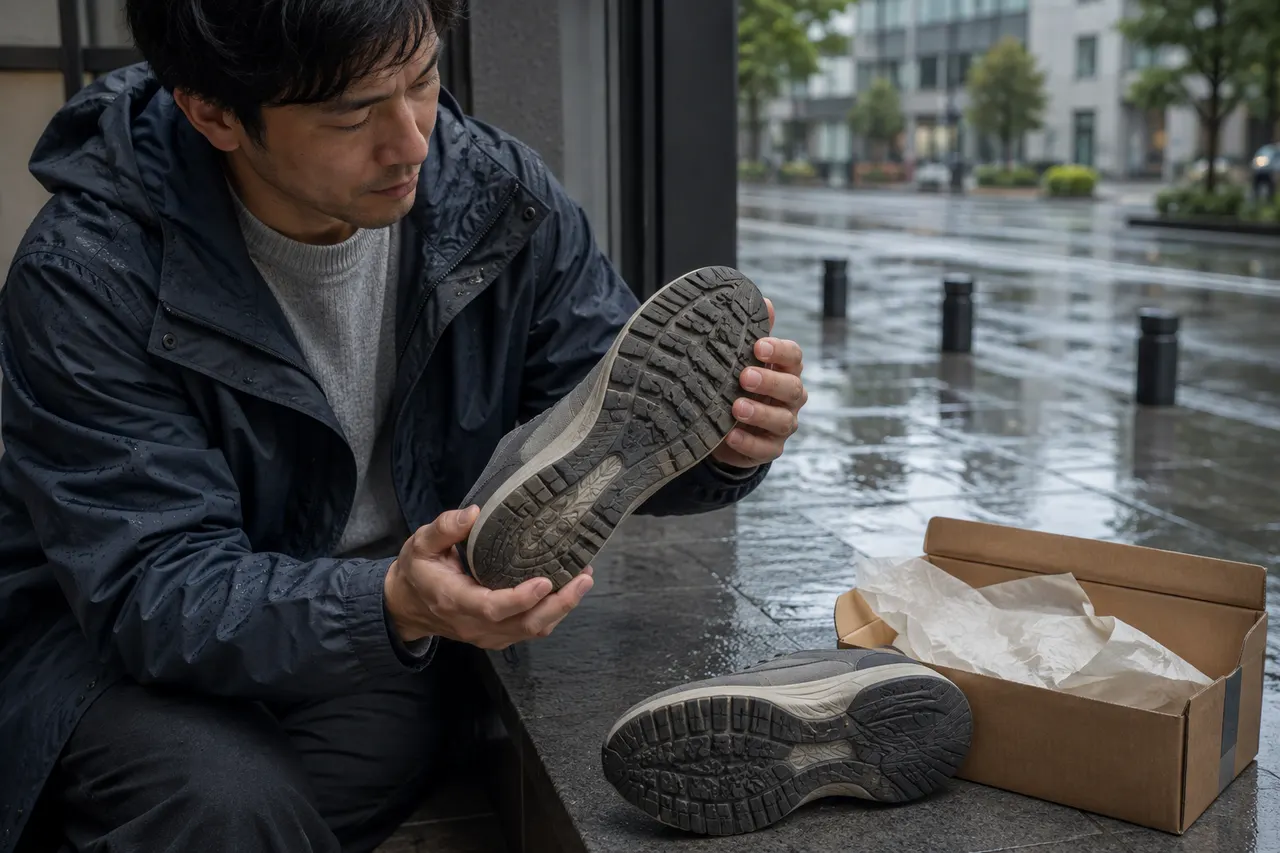
Caption: A schematic of road surfaces, outsole tread patterns, wear zones, and image verification points for wet-weather commuter shoes.
Clarify your wet-weather commute route and main slippery surfaces
Don't choose shoes first; first, break down a complete commute route. Different surfaces require different outsole characteristics:
Smooth ceramic tiles and polished stone: after water accumulates, a continuous water film easily forms, so prioritize checking outsoles with too-shallow tread or overly flat contact areas.
Subway station metal covers, stair nosing, and escalator steps: surfaces are hard and smooth, and even brief steps can slip; stride and handrail habits are equally important.
Asphalt and rough concrete roads: usually drain quickly, but sand, leaves, and oil stains can change grip conditions.
Awning entrances and mall lobbies: soles transition from wet outdoors to smooth indoor floors suddenly, an often-overlooked transition zone in commuting.
Ramps, overpasses, and long staircases: need attention to heel strike stability, forefoot propulsion, and sole flex points.
It's recommended to record the longest stretch of wet slippery surface, not just the total distance. If only a few dozen meters of wet ground daily, the candidate range can be broader; if the route includes long slopes, smooth tiles, or frequent stair climbing, raise the evidence threshold. 🔍
Distinguish product page specs, visible details, and unverified slip-resistance claims
When viewing candidate products on fish-goo.org, separate information into three layers:
Page-specific specs: for example, outsole material name, shoe weight, shoe type, and size information. Only record if clearly shown on the page, and note the verification date.
Image-visible details: for example, rubber coverage area, tread direction, groove shape, local wear, and adhesive edges. Images can only support appearance judgments.
Performance claims: such as "non-slip," "all-weather," or "stability in rain." Without test methods, test surfaces, contamination conditions, and comparable results, treat these as seller claims, not verified performance.
"Rubber outsole" is also not a sufficient conclusion. Rubber formula, hardness, contact area, tread depth, and wear level all affect performance, and ordinary product images usually cannot confirm these variables. Even if the page provides a material name, avoid directly inferring wet-surface grip.
Check outsole rubber coverage and forefoot/heel tread direction
First, find a complete, directly facing, and clear sole image, then examine the heel, arch, and forefoot separately. 👟
Heel area key checks:
Whether the lateral landing zone has continuous rubber coverage.
Whether tread is worn smooth or hidden by camera angle.
Whether the heel is occupied by large smooth foam.
Whether coverage shape and tread are consistent between left and right shoes.
Forefoot area key checks:
Whether the propulsion zone has transverse or multi-directional tread, not just decorative lines.
Whether there is visible rubber contact under the big toe and lateral forefoot.
Whether tread extends to main load-bearing positions.
Whether there are excessive bare foam gaps between individual rubber lugs.
Tread direction only helps infer design intent and cannot alone prove slip resistance. A single longitudinal groove may aid water drainage fore-aft but may not resist lateral sliding; complex tread can also lose effectiveness if too shallow, too dense, or clogged with mud.
Assess drainage grooves, contact area, and flex point trade-offs
More grooves do not mean safer. Deep grooves may help water and debris leave the contact area but reduce instantaneous contact area; large flat rubber areas have higher contact but may more easily form a water film. When judging, look for a balance suited to your commute route, not a single feature.
Also observe the outsole flex line. Normal forefoot flexing typically occurs near the ball of the foot. If deep grooves form an overly concentrated flex line, over time it may become a point for wear or cracking observation. Static images cannot prove durability but can indicate areas to recheck after receiving the shoes.
For wet-weather commuting, practical static candidates typically have: clear coverage in main load zones, recognizable tread on both forefoot and heel, grooves not obviously worn smooth, and clear sole photos. "Candidate" here only means worth further verification, not that wet-surface performance testing has been passed.
Check lateral heel and forefoot wear zones based on walking frequency
Standards for wear inspection should differ between occasional weekly walking and daily high-frequency commuting. High-frequency walkers should list the following positions for receipt inspection and follow-up checks:
Lateral heel: most people's initial landing zone, localized smoothing changes landing stability feel.
Medial forefoot: experiences significant force during propulsion; reassess for wet use if tread disappears.
Lateral forefoot: may bear extra load during turning and lateral movements.
Rubber-midsole junction: watch for peeling, separation, excess glue, and irregular gaps.
Corresponding zones on left and right shoes: obvious asymmetry may come from manufacturing variance, positioning, or usage; request additional images to confirm.
If product images already appear dusty, scuffed, or locally shiny, don't immediately assume wear, nor ignore it. The correct action is to save the image and request a close-up from the same angle; if unable to get additional images, factor uncertainty into the drop criteria.
Use an image checklist to inspect left/right soles and adhesive edges
Image verification is best done in a fixed order to avoid being swayed by upper colors or marketing copy. 📷
Before ordering or when warehouse inspection images are available, confirm in sequence:
A full frontal view showing both left and right soles together, covering complete heel and toe.
A close-up of the left heel lateral side, showing tread edges and rubber coverage clearly.
A close-up of the right heel lateral side, shooting distance and angle as consistent as possible with the left.
Close-ups of left and right forefeet, comparing tread under big toe and lateral forefoot.
Adhesive edge images around the entire shoe, focusing on toe, arch, and heel.
Size label and order spec image, but before sharing screenshots, cover name, address, phone, order number, and payment information.
When comparing left and right shoes, only compare images at the same angle, lighting, and similar distance. Shadows can make shallow tread look deeper, and wide-angle distortion can alter sole proportions. If the current order page on fish-goo.org allows requesting additional photos, you can make specific shooting requests based on the gaps above; if the page lacks this feature, don't assume the platform can provide them.
Set judgment boundaries when lacking wet-surface tests or material info
Without wet-surface tests, at most you can judge "whether the outsole design is worth further verification," not "will definitely be non-slip in rain." Without material info, you cannot determine an area is rubber based solely on color or surface sheen.
Use these boundaries:
Clear sole images but no test data: can enter candidate list, marked "static appearance passed, wet performance unknown."
Material name but no clear images: request full sole images; don't retain based solely on text claims.
Only "non-slip" description: record as unverified claim, do not increase candidate priority.
Images blurry, cropped, or only show one shoe: request additional images; if unavailable, downgrade or drop.
Work environment requires certification: check formal proof required by employer or local standards; ordinary commuter shoe selection does not apply.
After receiving shoes, do not test directly on slopes or near traffic on the first rainy day. First observe in a safe, flat area with handrails, using short strides, then decide whether to continue based on actual conditions. No outsole can eliminate risks on oil, moss, ice, or smooth metal. 🛑
Build a wet-weather candidate list and decide on image requests, retain, or drop
For each candidate, record only traceable information: page product name, verification date, that day's price and currency, size status, seller's original material description, whether sole images are complete, main concerns, and next action. Prices and stock change, so screenshots cannot replace rechecking before ordering.
Finally, handle with three outcomes:
Request images: main load zones obscured, left/right angles inconsistent, adhesive edges unclear, and product still has comparative value.
Retain: route needs clear, full sole images clear, main contact area coverage and tread discernible, no unexplained significant differences between left and right; also mark wet performance unverified.
Drop: core images missing long-term, claims unverifiable, specs contradict images, or clear risk signals such as obvious smoothing, separation, or severe asymmetry.
This article has no verifiable product prices, shipping, or return cost samples, so the confirmed savings amount is $0; cannot claim any selection method definitely saves money. Actual comparable amounts should be calculated per order as "avoided product price, service fees, and shipping after dropping high-risk candidates, minus new image request fees or price differences for replacement candidates."
This method increases risk because static images alone may still misjudge material, tread depth, and actual wet performance. It suits ordinary commuters willing to keep verification records, able to request clear images, and accept performance uncertainty; it is not recommended for professional non-slip roles, extreme weather, long-term oily surfaces, or orders where complete sole evidence cannot be obtained.
Browse our latest products and find your next favorite item.