fishgoo Knit Tie Spreadsheet Guide
fishgoo Knit Tie Spreadsheet Guide
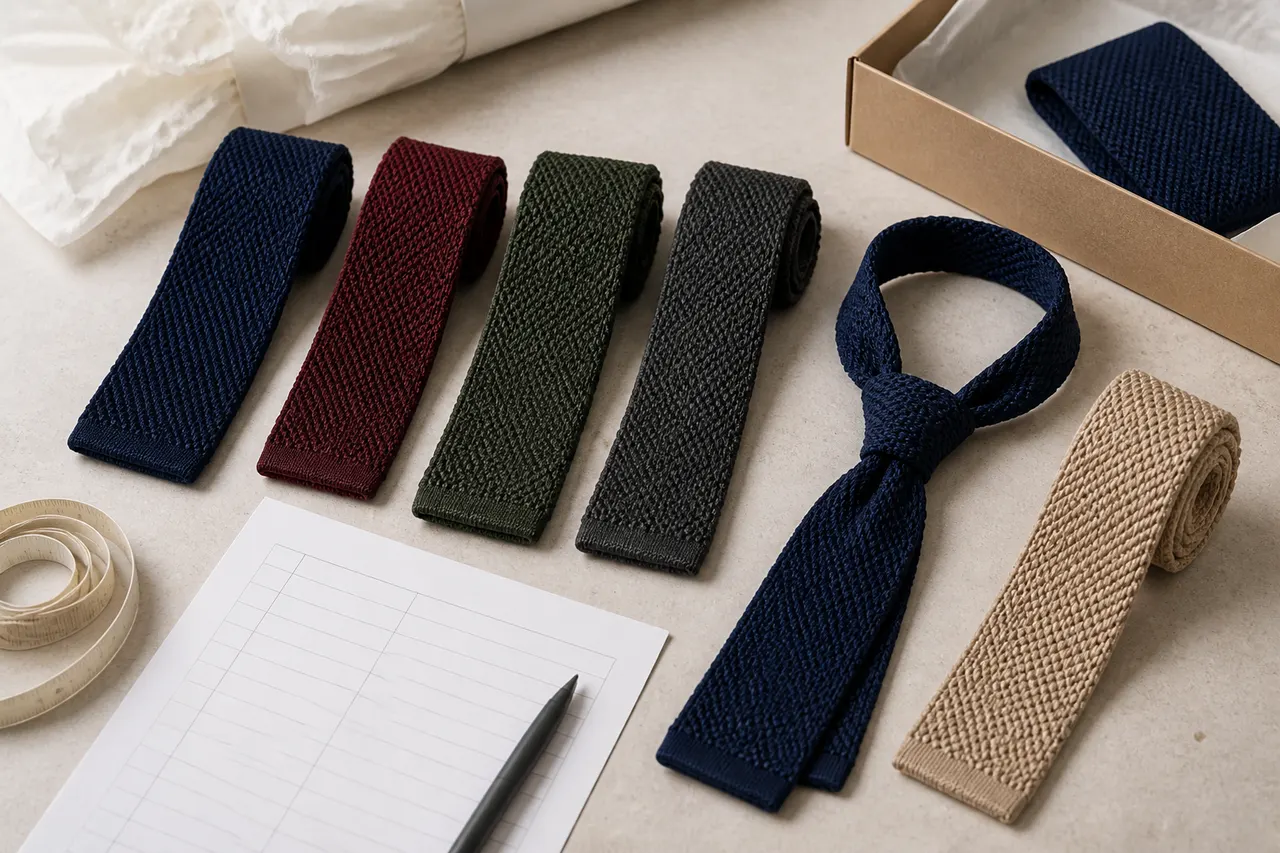
The difficulty in filtering knit ties isn't finding more styles, but judging whether the blade width, total length, weave texture, and thickness can simultaneously fit your shirt collar type, height, and common tie knot. This guide provides a filtering method for candidate products in the fish-goo.org spreadsheet, helping you use spreadsheet clues to go to product pages for verification, then decide to keep, inquire, or exclude.
This article does not provide unverified conclusions about stock, price, material, or quality, nor is it suitable for buyers who want to judge physical quality from thumbnails alone. Product status, fees, return and exchange conditions, and route restrictions are dynamic information; before ordering, rely on the page visible on the day and the platform's checkout results. The information check date for this article is August 27, 2026.
First clarify the shirt, collar type, and occasion for the tie
Don't search by color first. Take out the shirts and jackets you're most likely to pair with, and record the following conditions:
Whether the shirt has a narrow, medium, or wide collar
Whether the suit lapels are narrow, moderate, or wide
Whether the occasion is daily commute, casual gathering, or more formal business event
Whether you habitually tie the tie to near the belt, or slightly higher
Whether you commonly use the four-in-hand knot, half-Windsor knot, or another knot type
Knit ties usually have more texture than smooth woven ties, but "knit" does not automatically mean casual, nor does it mean all styles are suitable for formal occasions. Color, end shape, weave thickness, tie width, and shirt collar type collectively affect the overall look.
If the suit lapels are narrow, you can first look at relatively narrower candidates; when lapels and shirt collar are wide, an overly narrow tie may look disproportionate. This is a styling screening principle, not a fixed size standard; ultimately, actual measurements and trial proportions should prevail. 👔
What fishgoo Spreadsheet can tell you and what it cannot prove
The fishgoo Spreadsheet is better suited as a candidate entry point, not final product proof. The spreadsheet may help you quickly view product names, categories, images, seller clues, or product entry points, but whether each column reflects current status still needs to be verified on the corresponding product page.
The spreadsheet can assist you in:
Compiling multiple knit tie candidates
Initial screening by filled-in size, color, or style terms
Saving product entry points pending verification
Marking missing data to reduce repeated viewing
Establishing uniform comparison fields across candidates
The spreadsheet itself cannot prove:
That the product is still in stock or the link remains valid
That the current price matches historical records
That the material name is accurate and composition complete
That the image color exactly matches the physical item
That measurement methods for blade width and total length are consistent
That the seller accepts returns or exchanges
That the product is free from snags, skewing, loose threads, or seam issues
Therefore, a reasonable process is "discover candidates in spreadsheet, verify specs on product page, confirm dynamic conditions before ordering, and make another quality judgment after warehouse photos arrive." If spreadsheet records conflict with the product page, treat the product page's same-day information as the basis for confirmation and keep a record of discrepancies, rather than choosing more favorable numbers yourself. 🔎
Establish screening conditions by blade width, total length, and height needs
First, add four columns to your candidate table: "Blade Width", "Total Length", "Measurement Basis", and "Data Date". Don't directly delete products without clear size evidence; you can temporarily mark them as "to inquire", but they should not be placed on the same priority as candidates with confirmed sizes.
It is recommended to establish screening intervals as follows:
Screening Field | How to Record | When to Exclude |
|---|---|---|
Blade Width | Record width at widest point in centimeters and note flat measurement | When clearly disproportionate to collar type and jacket lapel ratio |
Total Length | Record flat length from one end to the other | When estimated after common knot type clearly cannot reach target position |
Size Evidence | Product page size chart, seller's written response, or warehouse measurement photo | Only blurry images and seller cannot provide additional explanation |
Error Range | Note seller's stated manual measurement tolerance | When acceptable error still causes length or width to be unsuitable |
Height can only be used as an initial screening condition and cannot alone determine tie length. Neck circumference, torso proportion, waist position, and knot type all affect the final hanging position. A more reliable method is to measure a tie you already own that fits well, record its total length and blade width under your common knot, and use that as a baseline for comparing candidates.
If you have no reference tie, you can use a soft tape measure to simulate the tie path, but reserve length for the knot. Thick knit fabrics usually consume more knotting length than thin fabrics, so comparing total length alone can still lead to misjudgment.
Compare differences between square-end, pointed-end, and various knit textures
Square-end knit ties have a distinct knit style and are usually easier to create a casual or retro feel; pointed-end styles are closer to common ties in silhouette, but formality still depends on texture, color, sheen, and overall pairing. Do not judge use solely by end shape.
When screening, you can break appearance into three fields:
End: square or pointed
Texture: fine, pronounced grain, or open weave
Surface appearance: matte, slight sheen, or impossible to tell from image
Fine texture is usually easier to coordinate with business shirts, while coarse grain or open weave emphasizes texture and suits more relaxed outfits. However, product images may be compressed, brightened, or color-adjusted, and cannot prove actual feel, thickness, or sheen. If the page only shows distant views, mark the texture conclusion as "unconfirmed".
Color screening should also consider your existing wardrobe. Low-saturation colors like navy, charcoal, and burgundy are usually easier to combine, but this is only a color suggestion, not proof that the actual item color in a particular page is accurate. If color difference affects usability, check photos under natural or neutral light during warehouse inspection. 🎨
Check thickness and knotting space based on your common tie knot
The four-in-hand knot has a simpler structure and is usually more suitable for thick or space-limited knit ties. The half-Windsor knot is bulkier and requires more usable length, and may make the knot of a thick knit tie look overly bulky.
When assessing knotting space, check in order:
Does the product page provide side views, fold detail, or close-up texture images?
Is the neck area of the tie the same width as the blade, or is there a tapered design?
Are there thickness data or detail images that can help judge layers?
After tying with your common knot, can the remaining length reach your target position?
Can the shirt collar accommodate the knot without visibly pushing up the collar points?
If thickness figures are unavailable, you can request the seller or warehouse to provide a flat side view, but you cannot convert visual thickness in a photo to millimeters. Mark such candidates as medium risk, which is more reliable than arbitrarily writing "thick" or "thin".
Verify material labels, edges, seams, and size evidence
"Knit" describes the structure, not the specific fiber content. Polyester, silk, wool, cotton, or blended materials may differ in sheen, elasticity, care, and wear performance. If the page only says "knit fabric", record the composition status as "undisclosed" and do not infer from images.
Before ordering, you can check:
Whether the material label lists specific composition and proportions
Whether the product title, detail text, and label images are consistent
Whether edges are straight and free of obvious waves, loose threads, or snags
Whether the two sides of the end are symmetrical
Whether the back seam is centered and continuous
Whether the size chart explains measurement positions
Whether different colors of the same style share one size chart
After warehouse photos arrive, prioritize checking silhouette, ends, texture, and seams. When you spot concerns, make specific requests within the window for additional photos or after-sales handling, such as "please lay the entire tie flat and place a ruler horizontally at the widest point". Don't just write "check quality for me", because such a request lacks clear judgment criteria. 📏
Warehouse photos also have limits: they can help identify obvious appearance issues and size differences, but cannot reliably prove long-term durability, fiber authenticity, wearing comfort, or changes after washing.
Before ordering, confirm color, care requirements, and return/exchange boundaries
Color names are not a universal standard. The same writing of "dark blue" can appear differently across sellers, batches, lighting, and screens. Record candidate colors alongside the shirts and jackets you plan to pair, and note the range of color difference you can accept.
Care information directly affects whether a purchase is worthwhile. Check whether the page states requirements for hand washing, dry cleaning, ironing temperature, or flat drying. Knit structures may deform after pulling, hanging, or improper cleaning, but you cannot assert that a style will shrink or stretch without specific material and care labels.
Before submitting an order, also confirm:
Are the current specifications, color, and quantity on the product page correct?
Are the product price and any possible service fees shown at checkout?
Does the seller accept unconditional returns or exchanges, and which situations are excluded?
Are there return/exchange restrictions for custom, sale, or unpackaged items?
After finding issues at the warehouse, what is the time limit for requesting additional photos, returns, or exchanges?
Are international shipping, destination country taxes, and import requirements calculated separately?
Do not ask for under-declared value or otherwise evade customs inspection. Declarations, taxes, and import restrictions should be handled according to destination country requirements, and keep order, payment, and product information. When dealing with account or after-sales communication, do not publicly share full order numbers, IDs, payment card information, or shipping labels.
Organize candidates and make the final selection
After verification, divide candidates into three groups:
Selectable: blade width, total length, material status, and appearance evidence meet your minimum requirements
Pending confirmation: style is suitable, but missing size, composition, color, or return/exchange information
Excluded: key dimensions unsuitable, evidence conflicts, or seller unable to clarify important issues
The final choice should not be "the best-looking one in the photo", but the one with the most complete evidence and best match to your usage conditions. You can record size fit, styling fit, evidence completeness, and after-sales risk for each candidate, but do not automatically treat missing information as qualified.
What this method may save is not a fixed amount, but the product cost and subsequent shipping cost caused by a size error, unacceptable color difference, or inability to return or exchange. Since this article has no verifiable specific product prices, shipping fees, or return costs, it cannot give fictional savings figures; you can calculate your own risk ceiling before checkout using "product price + service fee + estimated shipping allocation + cost that may not be recoverable".
Its added cost is screening and inquiry time, and it may cause some products with insufficient information but actually good quality to be deferred. It suits buyers who care about proportions, frequently use a fixed knot, and are willing to wait for size or warehouse evidence; it is not suitable for those who want to buy quickly, cannot confirm return/exchange conditions, or have no minimum requirements for material and size.
When blade width coordinates with existing clothing, total length covers your common knot, material description is not taken as physical proof, and dynamic fees and return/exchange boundaries have been reconfirmed, you have truly completed the selection, not just clicked open a product from the spreadsheet. ✅
Agent platform shopping FAQ
1. What categories of products are included in the fish-goo.org spreadsheet?
The fish-goo.org spreadsheet covers shoes, clothing, bags, accessories, jerseys, fragrances, hats, scarves, belts, and various household goods.
2. Why doesn't fish-goo.org use Google Sheets to display products?
Google Sheets is only suitable for tables with a small number of products. When the number of products increases, loading becomes very slow and the system lags noticeably, especially on mobile where the visual experience is poor and finding products is extremely inconvenient. For the same batch of products, the website spreadsheet on fish-goo.org loads faster and has a better visual presentation.
3. How can I find the product I want to buy on fish-goo.org?
You can search with a single keyword, or go directly to the category pages, where products are also organized by brand. Longer search terms usually return fewer but more precise results than short terms. For example, you can search "Air Force 1 White", "sneakers", or just "Air Force 1".
4. What should new users pay attention to when using the fish-goo.org agent platform for the first time?
Users who first access the Taobao agent through the fish-goo.org spreadsheet typically receive a new user shipping discount package. You should also check the step-by-step beginner's shopping tutorial guide.
5. How do you judge product quality on fish-goo.org?
To assess product quality, check the QC photos - don't rely solely on factory-provided images, because those are usually retouched. Use QC photos to confirm whether product details meet your specific requirements before deciding to actually purchase. Also remember to avoid extremely low-priced products, as they are usually not of good quality.
Browse our latest products and find your next favorite item.