Fishgoo Cufflink Backs Compared
Fishgoo Cufflink Backs Compared
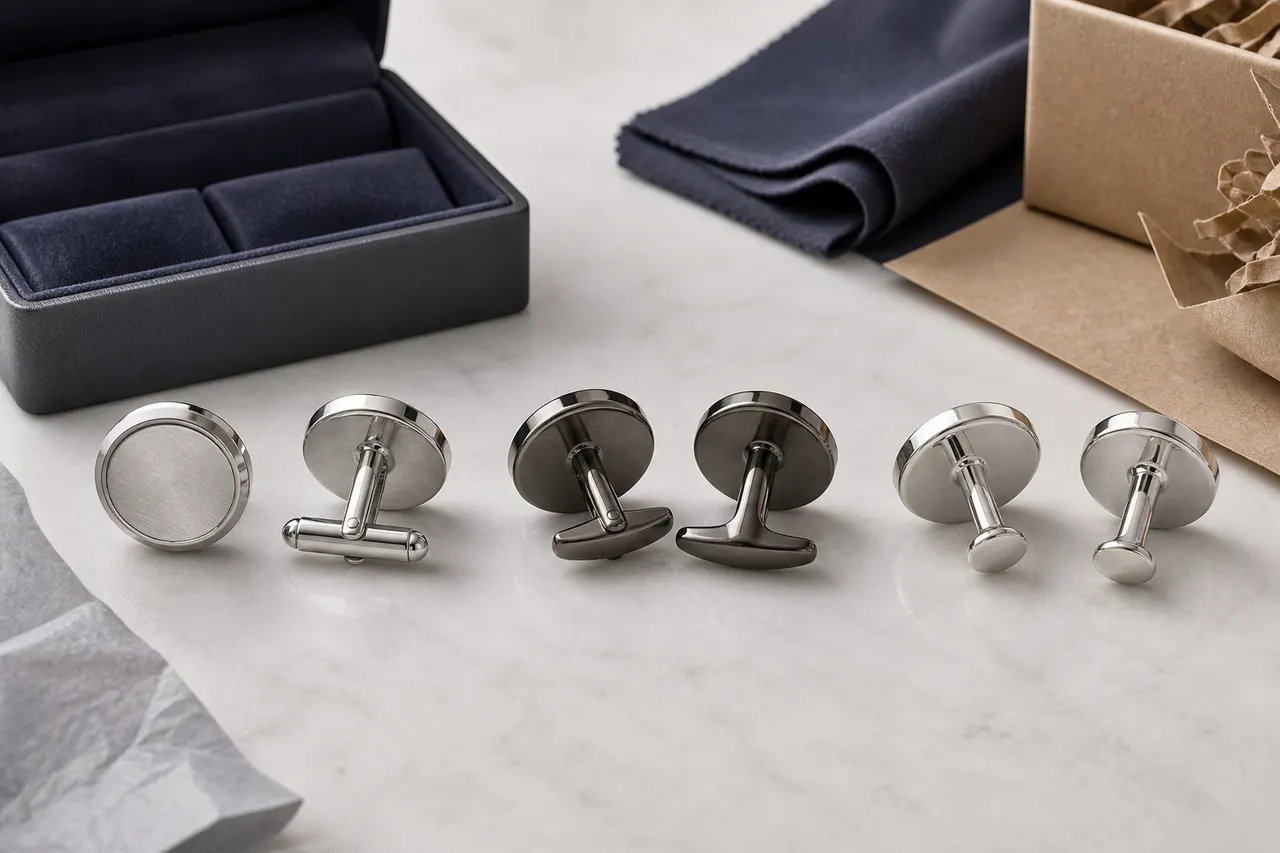
Cufflink back structures affect donning speed, number of moving parts, cuff fit, and ongoing maintenance, but the structure name alone cannot prove material, durability, or workmanship. This article helps buyers preparing to screen cufflinks on fish-goo.org build a shortlist based on visible product information and image evidence.
After reading, you should be able to rule out structures that don't suit your shirt cuffs or usage scenario, and list questions to confirm with sellers before ordering. This article does not apply to regular button cuffs, nor does it replace physical size checks, material documentation, or post-arrival inspection results.
This article's information boundaries were verified on August 30, 2026. Since there are no specific product pages, real-time prices, stock, shipping, seller commitments, or platform policies to confirm item by item, this article makes no current-valid assertions about such time-sensitive information.
First Confirm Whether Your Shirt Cuffs Are Suitable for Cufflinks
Look at the shirt first, not the cufflinks. Cuffs suitable for traditional cufflinks usually have buttonholes on both sides, requiring the cufflink to pass through and secure them. French double cuffs are a common form, and some single-layer cuffs may also have corresponding buttonholes.
When checking, complete three actions:
Align the cuffs as they would be worn, and confirm that the openings on both sides can overlap.
Measure the approximate thickness after overlapping, especially the total thickness from double-layer fabric, reinforced interlining, and formal shirt construction.
Check whether the buttonholes are large enough for the candidate cufflink's back components to pass through, yet not so loose that it easily slips off.
If the cuff has a buttonhole on only one side and the other side already has a sewn regular button, do not assume based on appearance that you can directly wear traditional cufflinks. Confirm the shirt design first, and consult a tailor if necessary. 👔
What Are the Differences Between Bullet Back, Whale Back, and Fixed Back Structures
Bullet back structures typically have a rotating bar-shaped closure. When putting on, first align the closure roughly parallel to the connecting post, pass through the buttonhole, then rotate to a horizontal position. Its operating logic is intuitive, and a common advantage is easy threading through the buttonhole; what needs careful checking is the pivot clearance and post-closure stability.
Whale back structures generally use a wider flip piece as the back closure. The flip piece is folded in to pass through the cuff, then unfolded to form a stop. The larger contact surface may be easier to grip, but actual thickness, profile, and operating feel still depend on the specific design; you cannot judge solely by the name.
Fixed backs have no flip closure; common forms include fixed discs, fixed bars, or decorative double-sided structures. Fewer moving parts does not necessarily mean more durable; whether it easily passes through the buttonhole, whether it digs into the wrist, and whether it adapts to thicker cuffs still need to be judged based on dimensions and front/back images.
Different sellers may use inconsistent structure names. If the title says "fixed back" but the images show a rotating component, rely on clear structure photos and seller confirmation, not just the product title.
Use a Comparison Table to Check Donning Speed, Moving Parts, and Thickness
The table below is for initial screening and does not represent that any specific fish-goo.org product has achieved the corresponding performance. Actual results must be verified against the candidate product's dimensions, images, and descriptions.
Structure | Typical donning action | Moving parts | Key check for cuff thickness | Priority checks |
|---|---|---|---|---|
Bullet back | Align post, pass through buttonhole, rotate to lock | Yes | Effective post length covers overlapping thickness | Pivot, horizontal closure position, signs of looseness |
Whale back | Fold flip piece, pass through buttonhole, unfold to secure | Yes | Folded profile and post length | Hinge area, opening angle, edge shape |
Fixed back | Pass fixed back directly through buttonhole | Usually none | Fixed back passes through buttonhole with adequate clearance | Back dimensions, edges, front/back connection |
"Fast to put on" is an individual operating result and cannot be directly guaranteed by the structure name. Those who often put on cufflinks one-handed may prioritize structures that are easy to grip and determine open/closed status; those with smaller buttonholes should particularly verify the maximum profile of the closure when folded. ⏱️
Choose a Structure Based on Commuting, Weddings, and Formal Dinners
Commuting scenarios generally prioritize ease of operation, a low-profile silhouette, and easy daily maintenance. Both bullet back and whale back can be shortlisted, but exclude styles with obviously misaligned pivots, inconsistent closure directions, or overly heavy decorative faces lacking structural support information. Fixed backs can also work for commuting, provided the back passes through the buttonhole smoothly.
Weddings may involve long wear times, frequent arm movement, and friction against suit cuffs. Don't focus solely on the decorative face when choosing. First check the shirt cuff thickness, then inspect whether the back edges are smooth, the post has adequate clearance, and a pair of cufflinks is consistent in orientation and closure position. If purchasing for a specific formal outfit, allow time for fitting and addressing issues before the event. 💍
Formal dinners place more emphasis on proportional harmony and complete detailing. Fixed backs or double-sided decorative structures may offer a more complete back view, but that does not imply they are superior. The mechanical structure hidden inside the cuff also needs to be reliable. If the product page lacks back images, do not finalize a decision based solely on the front design.
Regardless of the scenario, there is no universally best structure. A more sensible sequence is often:
Confirm cuff type and thickness.
Exclude candidates whose critical dimensions cannot be verified.
Inspect moving parts and connection points.
Finally, compare decorative styles.
Verify Dimensions, Material Markings, and Front/Back Details from Product Information
When building a candidate list on fish-goo.org, save the product title, page URL, verification date, and key screenshots for each page. Page accessibility does not mean the information is sufficient; at minimum, you need a clear product name and descriptions or images that support structure assessment.
For dimensions, prioritize finding decorative face length and width, effective post length, back closure dimensions, and overall thickness. If the page gives only one number without specifying which part it corresponds to, mark the dimension as "undefined" and do not assume it applies.
For materials, distinguish between appearance color, surface treatment, and base material. For example, a silver appearance does not automatically prove silver material, and gold does not automatically prove gold content. Even explicit labeling is not always sufficient to verify composition; buyers sensitive to materials, needing precious metal proof, or concerned about nickel contact risk should request more specific material descriptions or documentation.
For images, try to confirm at least:
Front decoration and edges are clear;
Back structure is fully visible;
Both open and closed states of the closure are shown;
There is a side view to judge post length and overall thickness;
The pair of cufflinks in the image is the same structure and orientation;
Dimension drawings have clear markings, units, and part names.
Prices, stock, available options, shipping, taxes, return conditions, and page status may change. Before deciding to purchase, recheck on the same day and record the currency, destination, and applicable conditions. 🧾
Check Image Evidence for Pivots, Closure Positions, and Pair Consistency
For bullet back and whale back structures, first zoom in on the moving parts. Observe whether the pivot is centered, connections are symmetrical on both sides, and there is obvious misalignment in open and closed states. A single front photo cannot prove pivot condition; at least a back or side close-up is needed.
For closure position, check whether the component, when opened, forms sufficient blocking, and assess whether it might easily return to a position parallel to the post. Static images cannot prove damping, elasticity, or long-term durability, so they can only be used to spot visible anomalies, not to prove service life.
Pair consistency includes decorative face orientation, post angle, closure length, and opening direction. If images show only one cufflink, you cannot confirm the other is identical; if multiple images appear to show different versions, confirm the final shipped version.
Before ordering, you can ask a specific question: "Please provide a same-frame photo of this pair of cufflinks with backs open and closed, and mark the effective post length." Such a request yields verifiable information more readily than a general "Is the quality good?"
After the goods arrive at the warehouse, if the purchase process provides inspection photos, use the structural evidence saved before ordering as a baseline to check the received style, quantity, front/back structure, and pair consistency. If existing images lack sufficient angles, first confirm whether additional desired views can be provided and any associated conditions; do not assume any add-on service is free or necessarily available. 🔍
What Conclusions Cannot Be Drawn When Detail Images Are Missing
Without back images, you cannot confirm the specific closure structure or determine whether moving parts exist.
Without side images or marked dimensions, you cannot judge whether the post fits thicker cuffs, nor determine whether a fixed back will pass through the buttonhole.
Without open/closed state images, you cannot confirm the rotation direction, open position, and visible symmetry of bullet back or whale back components.
Without clear material descriptions or proof, you cannot treat color, luster, or product name as evidence of material composition.
Without same-frame pair images, you cannot confirm that two cufflinks are consistent in orientation, structure, and surface condition.
Without product pages, seller confirmation, or warehouse evidence, you certainly cannot use definitive conclusions like "durable," "genuine," or "guaranteed not to loosen." Images can support visual observation but cannot replace tactile feel, internal structure inspection, or long-term use testing.
If key evidence is missing, the correct action is not to guess but to mark the candidate as "to be confirmed" or exclude it directly. ⚠️
Build a Candidate List and Make the Final Selection
Record the following fields for each candidate: product name, structure type, page verification date, whether front images are complete, whether back images are complete, whether open/closed states are visible, whether key dimensions are clearly defined, original material markings, questions to confirm, and final decision.
Final screening can use a three-tier result:
Keep: Cuff compatibility, structure, dimensions, and key image evidence all meet your minimum requirements;
To be confirmed: Style is suitable, but still missing one piece of information that would affect the purchase decision;
Exclude: Structure is incompatible with the cuff, or key facts are missing and cannot be reasonably verified.
If quick operation matters most for commuting, you can prioritize comparing bullet back and whale back folded profiles and gripping area; if you prefer fewer moving parts, look at fixed backs first, but you must confirm it passes through the buttonhole; if for weddings or dinners, raise the requirements for pair consistency, back appearance, and fitting time.
This method may save return/exchange costs caused by structure incompatibility, unclear dimensions, or insufficient image evidence, but it cannot guarantee a fixed amount saved. The added cost is time spent screening and asking questions, and you may miss styles with fast-moving inventory. It suits buyers who value cuff compatibility, structural evidence, and occasion matching; it is not recommended for those who want to order immediately without checking dimensions, nor for asserting specific materials or durability of a particular style in the absence of product details.
Agent Platform Shopping FAQ
1. What exactly are QC photos on fish-goo.org?
fish-goo.org has dedicated quality control personnel. After goods arrive at the fish-goo.org warehouse, the platform performs quality inspection and takes QC photos of your items. Typically three photos are taken, and the team checks whether the color, size, specifications, and quantity of the goods match the order, while also screening for quality issues. However, electronic products are excluded; for electronics, only appearance is checked. If any quality issues, size or color discrepancies are found, the team immediately requests a return from the seller, ensuring you receive quality goods.
Browse our latest products and find your next favorite item.